Flat Faced Breeds - cute or cruel?
Brachycephalic animals - otherwise known as flat faced breeds - are one of the major heath crises affecting pets today (Whether it be the trending pugs seen all over social media, or the ‘cute’ flat faced cats.) Today, I am going to take a look into the classification of the Brachycephalic traits, the health conditions most commonly found in these groups and the suggested solutions from many veterinarians.
Classification
The term Brachycephalic means short-snouted. It describes animals with a certain squashed face look about them. Brachycephalic animals can be classified on a scale from level 0 - 3, with 3 being the most affected with BOAS and level 0 being not affected by BOAS. BOAS stands for Brachycephalic Obstructive Airway Syndrome. It is important noting that not all Brachycephalic breeds are affected by BOAS.
In this post, I am going to be focusing on dogs, but other animals can be affected by BOAS such as cats and rabbits. The most common flat faced dog breed in the UK is the French Bulldog but other common breeds include: the famous Pug, the Shih tzu, the English Bulldog, the Boston Terrier and the Boxer. Currently, there are 24 dog breeds that are classified as Brachycephalic.
Different breeds have different risks of having BOAS. The University of Cambridge created a research study into the severity of BOAS in different breeds. Their infographics page was particularly useful for me as I conducted my research. They provided a pie chart of the percentage of the dogs studied in each category, using their own “BOAS index”.
This research was done using a “whole-body barometric plethysmography” to measure the respiratory function of these dogs. This works by placing the dog in a pressure chamber and measure the difference in pressure. This shows how effectively the dog is able to breath. Dogs can be taken their to participate in the study, whilst simultaneously showing owners how BOAS may affect their dog and whether further action should be taken.
Health Issues
BOAS - Stenotic flares. This essentially means that the dog has pinched nostrils which prevent effective breathing. - Elongated soft palate which means that the tissue at the back of the dogs mouth is too thick which can reduce the effectiveness of breathing causing things such as heavy breathing and snoring. - Hypoplastic trachea, which means that trachea is narrower that it should be leading to breathing difficulties - Extended nasopharyngeal turbinates which means that there are extended pieces of bone that normally are used to warm air, which reduce the air that can reach the lungs. - Laryngeal collapse which means that cartilage which is mean to support the voice box weakens and hence reduces the airflow to the lungs
Cherry eyes - This is a condition where the tear gland becomes swollen. It is not normally painful, but it is important to sort out as the tear gland is essential to eye health.
Spine issues - Lots of BOAS dogs have spinal defects which can cause difficulties in walking and pain in the spinal area. Two common problems that these dogs face in their spine are Spondylosis and Lumbar Disc disease.
Heat stroke risk - Many flat faced breeds have issues cooling themselves down as are unable to pant as effectively as another dog would due to their short muzzle. As dogs are unable to sweat to cool themselves down, many dogs with BOAS have a much higher heat stroke risk. The Brachycephalic Working Group reported that “Over a third of owners of brachycephalic dogs have reported that heat regulation is a problem for their dog” and that “(English) Bulldog: 14 x risk compared to Labrador Retrievers”
Skinfold Dermatitis - This happens when there is an infection between the skin folds. This can be painful, smelly and sore. This can be further exacerbated by the animal being overweight.
Dental issues - Caused due too many teeth packed into a very tight space. This can cause Malocclusion where teeth are out of line leading to ulcers and eating issues. It can also cause lots of infections in the mouth as there are more tight pockets where bacteria is able to grow.
Obesity - BOAS dogs are more likely to become obese compared to mesocephalic dogs (normal snouted dogs). This is because their ability to breath is limited meaning they get out of breath much more easily. Furthermore, the issues that come with obesity are much worse for these dogs. Obesity may cause extra strain on the larynx, further skinfolds and strain on the spine which only exacerbates previous issues.
Breeding
Many organisations speak out against the breeding of Brachycephalic animals such as the RSPCA. It is technically currently still legal to breed Brachycephalic animals in the UK. However, in one of the animal welfare laws it puts bans in place for a person to breed a dog which would end up suffering as a result. An article from VetTimes claimed
“Owners who breed from moderately or severely brachycephalic dogs are likely to be committing animal welfare offences”
In the article, the analysis argued it could be illegal to breed dogs with a BOAS score of 2 or 3 in the UK.
In the Netherlands, the breeding of Brachycephalic animals was banned back in 2014 (this was later enforced properly in 2019). Then in January 2023, the ownership of Brachycephalic animals was completely banned.
Vet advice
Many Vets speak out against the suffering associated with Brachycephalic breeds, actively discouraging owners from purchasing these dogs without sufficient prior research.
However, vets also appreciate the importance of not being judgmental around owners who decide to purchase these breeds - often people will get defensive when confronted. Many people do not understand the complications that comes with animals with severe BOAS. Fundamentally, both vets and owners want to help the animal be as happy and healthy as possible. This is why communication between vets and owners is highly important. Vets try to advise owners on how best to care for their flat faced breed.
Some advice from bluebell vets website include:
- Four/five small meals rather than large ones to reduce fullness. This may impact the breathing ability of dogs
- Keep them cool
- Resting respiratory rate
- Keep food bowls higher to encourage natural eating
- Reduce obesity
- Use a harness rather than a coller to reduce the harm to the windpipe
If the BOAS is extremely severe at grade 3, vets may suggest a BOAS surgery. This includes:
Rhinoplasty (widening of the nostrils)
Staphylectomy (shortening of the soft palate to remove obstruction to airflow)
Sacculectomy (removal of everted laryngeal saccules which increases airflow)
Removal of enlarged tonsils which also increases airflow
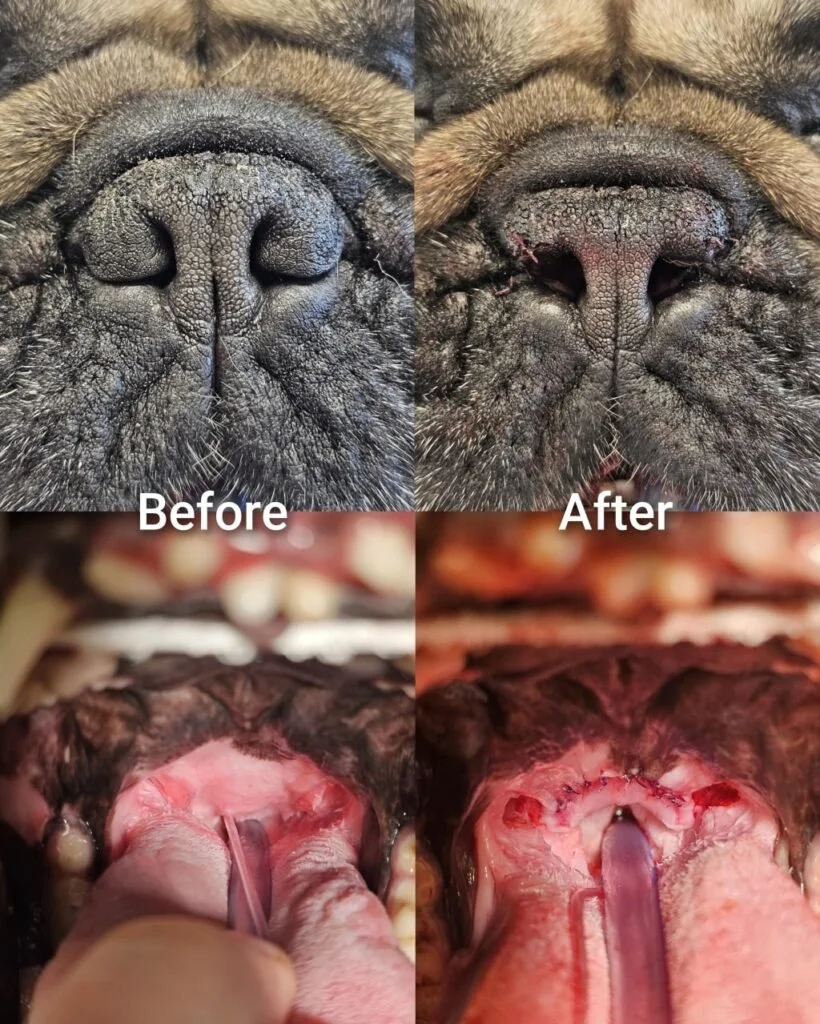
Here is an example of a BOAS surgery
The average cost of this surgery is £1850-3500. This is why at home measures are suggested first. Many pet owners may be surprised to learn about the issues of having a BOAS dog and so the price and extremity of this surgery may come as a shock to them. This is why it is so important to educate people on the breed of dog that they should purchase before committing.
Conclusion
Overall, I would say that I am surprised about just how many health conditions can be associated with brachycephaly. Breathing and conformation links to almost every aspect of a dogs life in chasing a ball or just sleeping without heavy snoring. I think that this issue should be highlighted more in the media than it is now. Everyone wants to do what prevents suffering whether that be choosing to exercise your flat-faced breed, BOAS surgery (in more extreme cases) or just trying to avoid purchasing a dog with Brachycephaly (creating a space for another dog to be bred). If you really want a Brachy breed, rescues are the place to look.
Please note that I am not a Veterinary professional and so am not qualified as a source of information. If you have concerns about an animal please contact a vet.
Links to websites used to create this blog post
https://www.humanevma.org/brachycephalic
https://vcahospitals.com/know-your-pet/brachycephalic-airway-syndrome-in-dogs
https://clydevet.com.au/preventative-vet-care/brachycephalic-breeds/
https://www.pdsa.org.uk/pet-help-and-advice/pet-health-hub/conditions/skin-fold-dermatitis-in-dogs
https://northbayvetdentist.com/common-dental-problems-for-brachycephalics/
https://www.bsava.com/article/research-shows-pugs-at-highest-risk-of-obesity/
https://www.rspca.org.uk/adviceandwelfare/pets/genetics/caring/rabbits
https://www.youtube.com/watch?v=pf54QoU9lRM
https://www.youtube.com/watch?v=jFBiHeI2WlU
https://www.routledge.com/rsc/downloads/10.1201_9780429263231-5_chapterpdf.pdf
https://www.bluecross.org.uk/advice/dog/health-and-injuries/cherry-eye-in-dogs
https://www.animaltrust.org.uk/services/boas
https://bluebellvets.co.uk/a-complete-guide-of-boas-surgery-cost-for-uk-pet-parents/
Images
bluebellvets.co.uk/a-complete-guide-of-boas-surgery-cost-for-uk-pet-parents/